Movement is fundamental to nature. There are so many forms of movement that we have specific descriptive terms for various types. For example, the Earth revolves around the Sun, all the time rotating on its axis. Earthquakes jolt, and earthquake-proof buildings oscillate during shocks. These are all inanimate movements, and usually repetitive. Animal movements are described with words like crawl, jump, run, dance, slide, swim, swoop, dive… They are not repetitive and are governed by the conscious will of the animal. In this article, I will examine the basic principles of movement in animals.
There are two external forces that affect locomotion in animals. These two forces are gravity and friction. Gravity is an attraction directed towards the Earth, and friction is a force at the junction of two surfaces that impedes relative movement. To move, an animal has to work with gravity and friction where possible, and counter it when necessary. In locomotion, animals take advantage of a process formulated by Newton as the third law of motion: “Every action has an equal and opposite reaction.” Stated simply, if you push on something, it resists the force by pushing back equally. Throw a ball at a wall, and the wall pushes the ball back at you with a similar force. Friction between the limb and the surface provides the force for the action, and the reaction launches the animal in the opposite direction with equal force (see Figure 1).
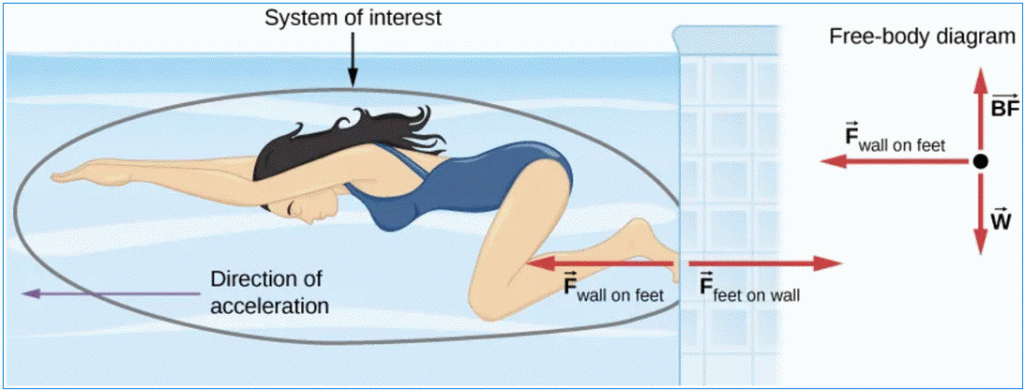
Figure 1: When the swimmer exerts a force Ffeet on wall on the wall, she accelerates in the direction opposite to that of her push. This means the net external force on her is in the direction opposite to Ffeet on wall. This opposition occurs because, in accordance with Newton’s third law of motion, the wall exerts a force Fwall on feet on her, equal in magnitude but in the direction opposite to the one she exerts on it. The line around the swimmer indicates the system of interest. Reproduced from: https://openstax.org/books/university-physics-volume-1/pages/5-5-newtons-third-law. Credits: Image and figure legend from OpenStax Physics under a Creative Commons Attribution License 4.0.
Single-celled organisms such as bacteria and some protists use hair-like structures called flagella or cilia, or undulations of the cell membrane to push against their watery environment, propelling their motion. This is analogous to using an oar on a boat to move the boat forward by pushing the water back. Larval stages of the most ancient animals, sponges, use cilia to move from one place to another, but then settle down and attach themselves to the surface to mature into sessile adults. More developed than the sponges are jellyfish. These animals generally float with the current, but have evolved a layer of primitive muscle – cells that cooperate and coordinate to contract and expand. This allows the bell of the jellyfish to push water down and move upward. Later animals evolved senses such as vision, hearing, and taste to identify the location of prey and pursue it through water. Then, in a huge step for animals, they moved onto land.
Water provides buoyancy but land does not. This means that the attraction of gravity requires more force to resist it. Jellyfish, perfectly mobile in water, become lumps of immobile protoplasm on land because their muscles are too weak to push hard enough to overcome the forces of gravity and friction on land to move the weight of their own body.
Very, very thin flatworms do propel themselves on land, but they need a film of water that they can glide on, because it reduces friction against the ground, in the same manner as water sheeting on the road will cause your car to hydroplane.
More advanced animals such as earthworms have evolved a clever solution, a tube filled with liquid inside their bodies that provides rigidity, and leverage for muscles to push against. The way this tube works is like a flexible water hose. When there is no water inside, the hose can be flattened and is floppy (like a flatworm). Fill it with water, and the hose becomes rigid, acting like a hydrostatic skeleton to provide leverage for muscles. Earthworms can burrow through soil, a pretty dense medium, using this method.
Standing up vertically to gravity requires more robust support. This support comes in two forms, as exoskeleton or shells on the outside, or endoskeletons or bones on the inside. Invertebrates largely have exoskeletons of calcium carbonate or chitin, whereas vertebrates largely have internal scaffolding made of cartilage or bone. Starfish are an exception: they are invertebrates but have endoskeletons.
Bones develop by calcification of the dense connective tissue of cartilage. To test this transition, feel your nose. The tip wobbles: it is made of cartilage. The bridge of your nose does not wobble: it is made of bone. Sharks and rays have skeletons made of cartilage, and other fish, amphibians, reptiles, birds and mammals have bone. Bones are more “advanced” because they have been coopted to provide other functions besides muscle attachment. Bone marrow is a site of hematopoiesis or blood cell formation. Skeletons also protect internal organs from damage. The ribcage protects the fragile heart and lungs, and the skull the brain.
The animal’s muscles are attached to the skeleton, and when muscles move in locomotion, they push against what’s outside: the ground for terrestrial vertebrates, water for aquatic vertebrates or air for flying vertebrates. Their internal skeletal framework keeps the body structure intact even when lacking the buoyancy of water. Thus fish have form on land, unlike jellyfish.
Invertebrates lack an internal skeleton, but they have an external sheath around their bodies that provides the same attachment and protection functions as the internal skeletons of vertebrates. These sheaths can be made of sclerotized chitin of various thicknesses, such as the outsides of bees and crabs, or of calcified deposits such as the shells of mussels and oysters. Cuttlefish, a type of squid, has an internal calcified shell (erroneously called a cuttlefish “bone”) that those of you who have reptiles and birds often feed to your pets as a source of calcium. These exoskeletons provide the same source of attachment to muscle that internal skeletons do for vertebrates. Since exoskeletons cannot expand, growth often involves a process of “shedding” the skin, a process known as ecdysis. Although snakes shed periodically, their “snakeskin” is not part of the skeleton, but a dead external layer of skin. Humans too shed the external layer of dead skin but in flakes, not as a single piece.
You may be recalling the structures of reptiles such as turtles, and scoffing at my simplistic description of an “internal vertebrate skeleton” vs. “external invertebrate shell” scheme, but there is more to thick skin than is apparent at first glance. In a pachydermous animal (elephant, rhino, pangolin, or armadillo, for example) the skin is actually partially keratinized. The “shell” of turtles is also thick and leathery “keratinized” skin which is additionally attached to the skeleton. Keratinization is the term given to the presence of crosslinked fibrous proteins that provide structural support. The equivalent term for invertebrates is sclerotization. Both these are largely made of dead cells filled with water-resistant proteins. Keratinized skin is not usually directly attached to muscle, but the shells of turtles are.
The fundamental structural unit for locomotion is skeletal muscle. Skeletal muscle fibers of both vertebrates and invertebrates are long and multi-nucleate. They are covered with elastic connective tissue that provides blood and nerve access. Many fibers are packaged together in bundles called fascicles. A bundle of fascicles is a muscle, and is covered by a sheath. The sheath is enclosed in a thick fibrous tissue which forms rope-like cords at the ends of the muscle, called tendons. Tendons attach to bone, linking the contractile action of the muscle to the movement of the skeleton in vertebrates. Insects contain only voluntary skeletal muscle, which moves at the will of the animal, and lack involuntary cardiac and smooth muscle, which moves autonomously. Muscle fibrils extending from the insect’s skeletal muscle interdigitates with tendons the epidermis. Fibers from the epidermis extend through pores into the cuticle, linking skeletal muscle to the exoskeleton. When the cuticle sheds during molting, epidermal connections to skeletal muscles remain intact, but the fibrils linking the epidermis to the cuticle dissolve and are reforged with the new cuticle [1].
Typically during a contraction, nerve impulses sent to the skeletal muscle cause two types of proteins called actin and myosin, arranged lengthwise along the muscle fiber to slide along each other, causing the muscle to contract in an energy-dependent manner. This links the periodicity of the nerve impulse to contraction for muscles used in walking in both vertebrates and invertebrates, and these muscles are considered synchronous muscles.
Flying insects require their wings to vibrate at very high frequencies to stay airborne. In these flight muscles, contraction and expansion are dissociated from nerve impulses. These muscles contract asynchronously to the nerve impulse. Insects have only skeletal muscle although their skeletal muscles are classed as synchronous when they contract once in response to each impulse, and asynchronous if they contract multiple times per impulse. Asynchronous contraction is the norm in insect flight muscles.
Insects also have antagonistic muscle pairs, such as flexors and extensors.
There are other types of muscle too in vertebrates: cardiac muscle powers the heart, and smooth muscle lines organs. But as indicated earlier, insects have only skeletal muscles, no other types of muscles at all. Definitely food for thought. Or food for eating. Stir-fried bugs, anyone?
References
1. Chapman, R.F. The insects: structure and function. 1998: Cambridge University Press.
