The country of Lebanon was once called Phoenicia, from the Greek word phoinix for the color purple. Lebanon lies to the north of Israel, on the eastern shores of the Mediterranean. A sea-faring people who undertook long voyages, their sailing and trading acumen was unparalleled. Homer called these people Phoenicians – the purple people. But why name them after a color? Thereby hangs an epic tale of fashion and empire.
Fashion has been in fashion since humanity started clothing itself to ward off the cold or too much direct sun. It was quickly realized that adding trinkets to hang off fabric and bodily appendages could communicate rank and wealth. Thereby began the serious business of identifying materials which were rare enough to obtain at great cost, but attractive enough to arouse envy: sparkly stones, shiny metals, and snuggly fabric. The earliest fabrics were probably made from animal skins, primarily featuring leather and wool, and plant fibers. They may have been felted, such as by pressing it together causing it to compress and adhere, or woven from plant fiber or animal hair. Animal and plant fibers come in typically nondescript colors, so they were probably made more eye-catching by incorporating bird feathers, shells, and stones. The ability to dye fabric would additionally allow the wearer to signal rank and affluence. Stone and mineral dust is often colorful, and maybe someone tried to color the fabric itself with crushed stones only to find it didn’t work very well. Pigments made from crushed minerals like ochre and lapis lazuli require them to adhere to the fabric which would have been difficult, given the tendency of the wearer to move. Thus, these pigments were relegated to painting skin, walls of caves, canvases, and paper. Finding and mixing colorfast pigments that adhered tightly to fabric when the wearer was in motion was much more challenging.
The use of dyed fabric as status symbols followed after humanity adopted farming practices, building settlements and gathering into large communities. In his treatise, Republic, Plato uses his mentor Socrates as a mouthpiece to describe an ideal city, Kallipolis, in which people are divided into three classes based on aptitude: the producers, the soldiers, and the rulers [1]. Children are tested at an early age, and the most promising are trained as guardians who protect and rule, and the rest are trained as producers who specialize in tasks such as farming, art, and construction. The best of the guardians are identified and exposed to further training to become the rulers, the philosopher-kings, by exposure to high ideals, literature, and thoughts. But here’s the thing: guardians of the soldierly and ruling sort are forced to live in communes and are not allowed to acquire any material possessions whatsoever lest they use their higher faculties to amass wealth and power. The success of choosing a ruler by aptitude was put into action in Rome between 96 and 192 ACE and exemplified by the “five good emperors”: Nerva, Trajan, Hadrian, Antonius, and Marcus Aurelius. Philosopher kings all, they exemplified Plato’s good governance. But they did not eschew wealth and pomp, as Plato would have it; they wore blood-red togas dyed with Tyrian purple to flaunt their rank prominently. Lower echelons of the ruling class work togas with a thin stripe to signal their power to the plebian hordes. Tyrian purple was the most expensive, prestigious, and rare dye the world has ever seen and indicated immense wealth and power. So where did Tyrian purple come from? And what gave it this sort of prestige?
The legend goes that one day as Herakles (Hercules) was walking with his faithful companion along the seashore in the coastal city of Tyr around 1500 BCE, he noticed his dog’s mouth had turned red. The dog was fond of eating whelks – a type of predatory sea snail – crunching them up as they walked. Being an observant sort of chappie (which also stood him in good stead when he was completing his twelve tasks) Herakles realized that the pigment came from the snail. It’s use is of long antiquity – fabric with this dye dating back to 1000 BCE were found in the Timna Valley in Israel [2]. This established sea snails as the source of a pigment – and what a pigment! In its day Tyrian purple, as it came to be known, cost more per ounce than gold. It was so hard to make and was made in such small quantities that the governing class established “sumptuary laws” to restrict its use. Persian monarchs in the 9th Century BCE, Egyptian pharaohs, and the kings of Israel all reserved this color for royalty. During the height of the Roman empire, only the emperor was permitted to wear this color, from which the phrase “born to the purple” originated (see Figure 1). This purple color has gained the epithet “royal” to indicate this longstanding association.
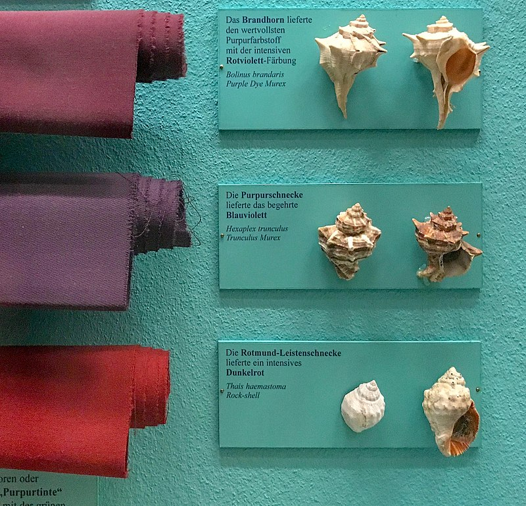
Figure 1: Left: Shades of Tyrian purple and the whelks from which the shades were derived. Different groups of snails produced different chemical combinations and thus different shades of the color, and intermediate shades could be produced by mixing the dyes from various origins. From: https://en.wikipedia.org/wiki/File:Haustellum_brandaris_000.jpg
The Tyrian purple-producing snails are members of the mollusk families Muricidae and Thaididae. Several genera: Murex, Thais, and Plicopurpura, produce mucus secretions which contain a mixture of indigo, mono- and di-bromo indigos together with indirubins. Bromoindigoes (Figure 2) are unique to these mollusks, and no other animal source of this molecule exists. The snails each produced a tiny drop of the mucus from their hypobranchial glands. To obtain that drop was immensely destructive: it took 12,000 snails to produced just 1.4 g of the dye [3]– enough to dye only a handkerchief. Pliny the Elder recorded in his book Naturalis Historia that the hypobranchial glands from the snails were extracted and fermented in open vats with a little salt, and the concoction the boiled until the right color intensity was obtained. The process reeked and the foul fishy smell that clung to the hands of the dye-extractors was so offensive that supposedly the Talmud allowed women to divorce a man who took up dye-making after marriage. But the dye was colorfast, and it darkened over time, making older garments even more valuable than new ones. Production of the dye from these snails was widespread – it occurred in Mexico, North Africa, and the near East, although I could not establish if the discovery of the dye itself was independent or not.
Other popular natural dyes, blue dyes were obtained from plants. True indigo (Indigofera tinctoria) was known in India from ancient times, hence the name; woad (Isatis tinctoria) was widely known and used in Europe. Other blue-dye producing plants are Japanese indigo (Polygonum tinctoria) and false indigo (Baptisia australis). The native Britons led by Boudicca who fought the Romans were known to use woad as war paint [4].
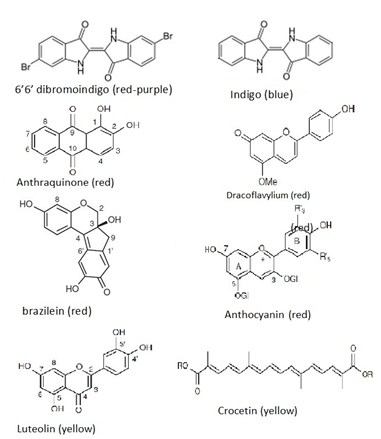
Figure 2: Chemical structures of naturally occurring dyes with their hue. Structures compiled from [5].
Red pigments were also spectacular and highly sought after, and their various animal and plant sources meant they were more readily available than purple. Kermes scale insects produced a crimson pigment known since antiquity. The pigment was extracted by drying and powdering the insects and then boiling them in a slightly alkaline solution. Similarly, cochineal, a carmine dye, was made from the cactus scale beetle, Dactylopius coccus, and enormously laborious, not to mention costly for the insects themselves: 17,000 were used to make one single ounce of dye. The lac insect, Kerria, produces both shellac and a red dye. All the insect reds were based on an anthroquinone chemical structure, and very stable. Plant sources of red dye are not lacking in interest. The country name Brazil originates from the name of a dye-producing tree called brasil. This wood produces a red dye is due to the chemical brazilein and hematein. Red colors also come from anthocyanins which are water-soluble pigments famous for coloring fall leaves red and flavyliums, which are resin exudates with names like Dragon’s blood. But by far, the most common and popular source of red (alizarin and purpurin) was rose madder (Rubia tinctorum), a widespread plant.
Yellow was abundant and common, ranging from carotenes (crocetin from saffron), curcumin, and luteolin (from various plants like clover and Salvia). The most famous use of yellow as an imperial color was by the Chinese Qing Dynasty who moved from using purple to a bright shade of yellow called “minghuang”. Yellow represented gold, and thus value. Further, the family name, Zhu, meant vermilion; using purple as the royal color undermined their own family name. But the imperial family used yellow, red and purple at various times and in different ceremonial functions.
The chemical synthesis of natural dyes and the production of synthetic aniline dyes made dyes of various shades available to the larger public. Still dyes tell stories and set moods. Brands carefully analyze the emotional impact of color choices, flags use colors that have symbolic meanings to the populations they represent. Even non-human animals use colors to signal their intent – think of the aposematic coloration of black and yellow of bees and wasps to repel predators, and the reds and yellows of flowers to attract pollinators, the bright shimmering colors of birds to attract mates.
Colors tell stories, and stories are always in fashion.
References:
1. Plato: The Republic | Internet Encyclopedia of Philosophy. 2021. https://iep.utm.edu/republic/
2. Sukenik N. et al. Early evidence of royal purple dyed textile from Timna Valley (Israel). PLoS One, 2021. 16((1)): p. e0245897. https://doi.org/10.1371/journal.pone.0245897
3. Wolk JL, Frimer A. Preparation of Tyrian Purple (6,6′-Dibromoindigo): Past and Present. Molecules, 2010. 15(8): p. 5473-5508. https://doi.org/10.3390/molecules15085473
4. Roberts, T. Woad in Britain from the Iron Age to Present. 2021; Available from: http://www.woad.org.uk/html/britain.html.
5. Melo, MM. History of Natural Dyes in the Ancient Mediterranean World. In: Handbook of Natural Colorants, ed. M.R. Bechtold T. 2009: John Wiley and Sons, Ltd. https://doi.org/10.1002/9780470744970.ch1

