This is the third in a series of articles about senses which living organisms use to probe and adapt to their environment. In the previous article, chemoception was described as probably the first sense to evolve and as encompassing both smells (olfaction) and taste (gustation). The difference between them is that smells are transported through a medium (air, water) to the sensors, whereas tastes make direct contact with the sensors. Temperature is related to the kinetic energy of atoms which jiggle and move. As a charged particle accelerates it emits photons depending on the degree of jiggling. Hotter temperatures = more jiggling = more energetic photons = smaller wavelengths; cooler temperatures = less jiggling = less energetic photons = longer wavelengths. When you use a microwave oven, you are irradiating food molecules with microwaves (which are a little longer than infra-red radiation), and when you cook on a grill, you are irradiating food with infra-red radiation. In both cases, the food’s atoms start jiggling more and they themselves start producing radiation. When you take a bite of the cooked food, infra-red photons produced by jiggling atoms start peppering the cells of your mouth. (When you eat something cold, heat moves to the food, and you feel the cooling sensation; your mouth does not emit photons, sorry.) If a lot of photons with smaller wavelengths in the infra-red are emitted, the food feels hot; fewer photons at longer infra-red wavelengths and it feels warm.
Thermoception is an evolutionarily more recent sensory tool than chemoception. It is used to prevent damage to the body due to extreme heat and cold and for hunting for warm-bodied prey. Warm-blooded ‘endotherms’ – birds and mammals which maintain a constant internal body temperature regardless of the ambient temperature – evolved more recently than cold-blooded ‘ectotherms’ – pretty much every other life form – whose body temperature and level of activity reflects the outside temperature. The evolution of warm-bloodedness had the impact of an earthquake, shaking up niches. It permitted animals to occupy areas of the planet where temperatures were colder without causing the organisms to go into a state of inactivity. For those animals that hunt at night when it is cool and there are fewer predators around, having the ability to sense body heat made hunting for warm-blooded prey more efficient.
Biological temperature sensing involves ion movement through channels called transient receptor potential (TRP) and K2P (two-pore domain) potassium channels. K2P channels sense background temperatures and set the ‘tone’. In TRP channels, the movement of ions causes a cascade that activates neurons which project to the temperature-sensing hypothalamus which is the ‘master thermostat’. Information is integrated from the somatosensory cortex (which tells the brain which part of the body is experiencing the temperature stimulus) and passes that information to the limbic system (the primitive part of the brain that forms pleasure/aversive and emotional affects). In some cases, temperature stimulus is short-circuited via spinal nerves in what is known as a ‘reflex arc’. This happens if you touch something really hot: your hand withdraws involuntarily.
TRPs are a collection of related transmembrane proteins [1] which physically transverse the cell membrane back and forth six times and then group up in clusters of 4. There are three main categories: TRPV channels sense heat and noxious heat (27°C and above), TRPM channels sense cool/cold (<25°C) and TRPA channels (of which humans have one, but insects have three) sense painful cold (<17°C). The temperature-sensing pits of pit vipers are extraordinarily sensitive to infra-red radiation. It is thought that photons are picked up by an unknown IR sensor, converted to heat which is sensed by TRPA1 channels in the membrane. Alternately, nerve endings which are present on the membrane could potentially directly transduce either the radiation itself, or the thermal sensation or channel activation to the brain. This is not clearly understood in snakes, but I’d just as soon not be messing with pit vipers either. The Melanophila beetle also senses heat, but differently: it directly senses photons without the involvement of TRP channels. Further, bacteria sense temperature, but without using nerves – their sensors are enzymes called kinases whose activity changes with temperature, and RNA molecules (a relative of DNA) which are prone to unraveling when heated due to the breakage of hydrogen bonds. As a protective response, bacteria also make heat-shock proteins which mitigate detrimental outcomes.
Plants seem to sense seasonal [2] changes by growing or shedding leaves, but they can respond to both light and temperature. Light is sensed through phytochromes and cryptochromes and responses include flowering. But those of you who like gardening will know that a certain amount of time in the cold, called vernalization, is required to germinate or flower. In these cases, temperatures are sensed by another phytochrome called PhyB. In cold temperatures, it is found in its Pfr (active) form, but warm temperatures cause it to change to its inactive Pr form, a mechanism known as ‘thermal reversion’. Plants also have TRP-like channels, and a mechanism by which their DNA loses attached molecules (histones) when it gets hot, triggering gene activation of warm-weather responses. Thermoregulatory homeostasis in plants can occur through transpiration-mediated cooling, or the production of heat in flowers such as the skunk cabbage’s spadix which burns carbohydrates to produce heat. [3] (Typically this is to cause the aroma to be dispersed to attract pollinators.)
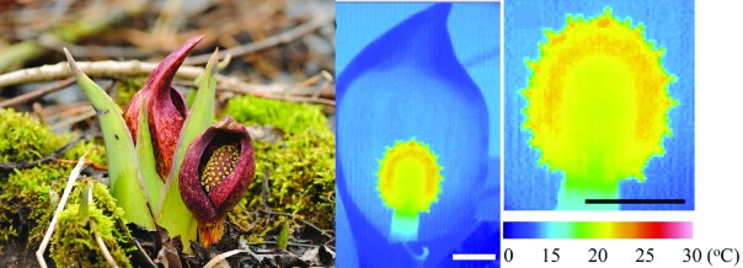
Figure 1: The skunk cabbage has a typical arum family flower with a bract that covers the central part of the flower. The central part displays all the reproductive parts. In the picture shown here, it is possible to see the yellow pollen exposed on the flowers of this plant. During flower maturation, the reproductive part heats up, reaching temperatures of over 20°C (about 70°F)! Center and right images show pictures of the flowers taken using a camera able to measure surface temperature, with a color scale that relates shown colors with temperatures. Photos: left: Janet and Phil; center and right: Onda et al. 2008. (Photograph and legend reproduced from Reference [4] under fair use).
The ‘thermal grill illusion’ produces a burning sensation when alternate warm and cold bars are sensed by skin. In this case, it is hypothesized that each pathway has its own nerves, and the cool nerves partially inhibit the sensation of pain from the cool stimulus. However, this causes the warm signal to paradoxically prevent inhibition of the pain pathway, leading to a sensation of burning. The same sensation can be experienced when methanol (which reacts with TRPA1) and heat (which stimulates TRPV) are sensed together, leading to pain. The spicy substance capsaicin triggers TRPV1 heat receptors, leading to a burning sensation. So when you say, “That’s really hot!” you are describing the sensation accurately.
Thermosensitivity can lead to strange outcomes. Certain reptiles’ sex ratios are determined by the temperature at which the egg is incubated. Some reptiles lack a sex chromosome, and their sex is determined by temperature exposure at a critical window during development. There are three types of patterns – a single transition temperature which produces females above it and males below (Pattern 1A, seen in most turtles); or males above it and females below (Pattern 1B, seen in the tuatara and some fish). In Pattern II, seen in turtles, lizards and crocodilians, there is a band of temperature in which males are produced with females being produced above or below the band. The reason is the thermosensitivity of the enzyme aromatase, which converts testosterone to estrogen. The bearded dragon has a chromosomal sex determination (ZZ = males; ZW = females). But exposure to high incubation temperatures can convert ZZ males into females who are fertile and can breed. The number of ZZ-females in wild populations of bearded dragons is increasing as global temperatures increase.
Honeybee populations monitor their hive temperatures within a narrow band between 34–36°C. Varroa destructor likes these temperatures, but researchers have experimented with thermotherapy – raising the colony’s temperature. 42°C for 3 hours kills adult Varroa destructor but also part of the honeybee brood, and affects drone sperm health, whereas 41°C for 2 hours kills immature Varroa destructor without affecting drone sperm viability. [5] Hopefully thermal treatment can be standardized to become one more tool against Varroa.
References
[1] The three groups of TRP channels are: Melastatin (M) channels, Ankyrin (A) and Vanilloid (V) channels, based on the molecules they recognize. V = vanilloid for recognition of capsaicin, which also contains ankyrin domains; A = ankyrin domains which connect membrane proteins to the cytoskeleton; M = melastatin, a type of domain structure lacking ankyrin but unusually having both channel and enzymatic activity.
[2] Imagine if the Earth were not tilted on its axis – we would have no seasons! The tropics would always be warm and sunny, and the poles always cold and dark! And all seasonal changes like fall colors and spring flowers would vanish.
[3] Typically, in the inner membrane of the mitochondrion, electrons from the breakdown of organic molecules are passed through the electron transport chain where a proton-motive force joins ADP and phosphate to make ATP, the energy molecule of the cell. Two mechanisms disconnect ATP production from catabolism of carbohydrates when heat generation rather than ATP production is required. The first uses the alternate oxidase (AOX) pathway. A second pathway uses uncoupling proteins (UCPs). When ‘uncoupled’, ATP is not made and that energy is dissipated as heat. Some baby animals have ‘brown fat’ where a similar uncoupling produces heat rather than energy. Brown fat levels diminish as an animal matures.
[4] Maryland Grows (2021). Some plants are not cool, skunk cabbage heats up. Available at: https://marylandgrows.umd.edu/2021/02/08/some-plants-are-not-cool-skunk-cabbage-heats-up/
[5] Kablau, A., Berg, S., Härtel, S. and Scheiner, R. (2019). Hyperthermia treatment can kill immature and adult Varroa destructor mites without reducing drone fertility. Apidologie. doi:10.1007/s13592-019-00715-7.
