Members of democratic organizations instinctively understand the concept of quorums. A quorum is the minimum number of members required to vote yes or no on a particular choice in order that the outcome is representative of the majority’s authentic choice. Assuming independent votes based on independent understanding, quorums are thought to produce the most judicious result possible. The Frenchman Marie Jean Antoine Nicolas de Caritat, Marquis of Condorcet, proposed this theorem in 1785 [[1]], and since then it has been applied to all manner of situations including votes for candidates in elections, juries pondering a case, and biological responses of populations of animals. Quorum sensing invites “critical mass” measurements which are then used by swarming bees and locusts to initiate gathering, by migrating flocks and herds to pick a departure time, and by pathogens setting up an infection. The term “quorum sensing” was introduced by Steven Winans in 1994, after brainstorming terms for the initiating chemical signal and rejecting these: gridlockins, communiolins, quoromones…[[2]]. Thank goodness.
What is not based on quorum sensing is called “stigmery”. These are progressions of those events that are influenced by spontaneous and indirect coordination (without communication), like such as the process of swarming by bees and locusts, the murmurations of birds and migrations of wildebeest which swoop and swerve, and the building of perfect hexagons in combs by bees and wasps. Local quorums may exist in these cases, but the behavior has several foci of action rather the whole group making a single collective decision. The concept of stigmery was introduced by Pierre-Paul Grasse in 1959 to describe insect coordination. Such pattern formation also happens through physical effects in bacterial colonies. A couple of examples of bacterial self-organization into patterns is shown in Figure 1. On the right are six beautiful patterns which resemble flowers or fungal growth but are actually made by the Gram-positive bacterium, Bacillus subtilis. Which of these patterns happens depends on environmental conditions and cues that may be produced by the organism itself.
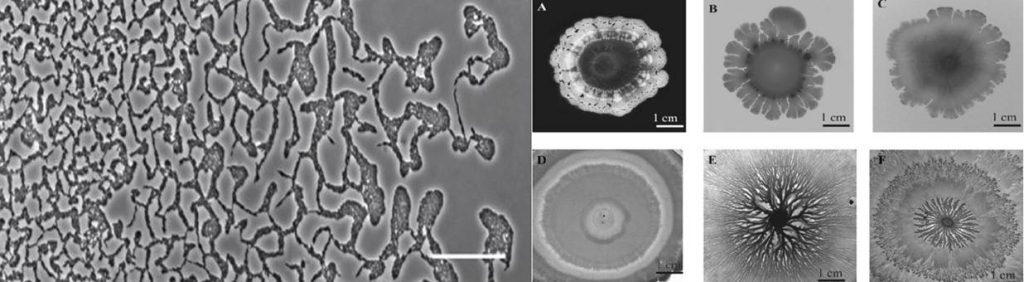
Figure 1: Bacterial self-organization by stigmery. Reproduced from [[3]] and [[4]] under fair use copyright for educational purposes. Figures have been slightly distorted to fit the page.
Beekman et al. [[5]] describe the formation of the classic pattern of brood and food storage in a comb in a process that exemplifies stigmery. It turns out the queen is not a happy traveler. She seeks to stay away from the periphery of combs for egg-laying and additionally prefers proximity to other brood-bearing cells. She therefore randomly moves about the central area of the comb filling empty cells with eggs. However, foraging bees who return with pollen and nectar don’t have a preference for location in the comb and will plop their gleanings anywhere there is space. But then, nurse bees who have the hard and thankless job of feeding the brood don’t have time to seek food; the closer pollen or nectar is to the brood, the quicker they will remove it rather than walking all the way to the periphery. But the randomly zig-zagging queen will drop an egg into the cleared cell, and the nurses curse under their breath and travel further and further to get food. As you can imagine, this leads to the brood being mostly in the center of the comb and the pollen/nectar at the periphery (Figure 2). The pattern emerges from randomness.
Figure 2: Locations of brood, pollen and nectar in a brood comb. Typically brood is densely clustered in the center-lower part of the comb in a semi-circle. Pollen is located in a band around the brood and nectar is usually located close to the frames. If projected three-dimensionally, brood makes an oblate sphere in the middle, topped with a layer of pollen and then a layer of nectar. Attribution: Figure modified under Creative Commons license from https://www.pexels.com/photo/a-man-in-a-bee-farm-for-honey-production-9375077/. Photo by Jenda Kubeš for Pexels.
On to quorum sensing. One of the key discoveries regarding quorum action is what Bonnie Bassler, Professor of Biology at Princeton University calls “tiny conspiracies”. I attended Bonnie Bassler’s lecture at Texas A&M University in the early 2000’s and it was an eye-opener! Not only is Dr. Bassler an accomplished scientist, she was an extraordinary speaker, both clear and entertaining. Her work on quorum sensing stemmed from a specific marine bacterium, Vibrio fischeri (a relative of Vibrio cholerae, which causes cholera). These bacteria are dispersed at low cellular densities in sea water where they are pretty much invisible. But they also take up residence in a symbiosis with squids in their mantle cavity where their higher cell densities leads them to exhibit bioluminescence using quorum sensing. These cells produce a quorum-sensing chemical called an “autoinducer”. When the bacteria are present at high densities such as in the squid’s mantle, the concentration of autoinducer builds quickly, re-enters the cells, and causes them to glow with bioluminescence through an operon (cascade of related genes) system called “lux”. At low densities the autoinducer diffuses outward, but does not build up in concentration and the lux system remains quiescent and dark.
Why is this significant? It’s because it is a way for cells to “sense” numbers. In many pathogenic bacteria, a similar quorum sensing mechanism exists for virulence genes (rather than bioluminescence genes). The virulence genes make the bacteria more capable of infection. Thus in lower cell densities the bacteria may remain as unwelcome guests, but they remain harmless. But when they pass a certain density threshold, they become capable of unleashing the virulence genes and causing disease. A lot like terrorists and sympathizers who build a “cell” and unleash havoc when the cell passes a certain number of adherents. But Bessler and her team also have developed a cool way to defang this virulence. They have harnessed the very tools the bacteria use in quorum sensing and turned the tables on the bacteria. They identified the signaling molecule and then modified it to interfere with the authentic signal. Then they released the modified chemical and found that the bacteria could no longer sense the quorum because of interference by the blocking molecule. One of the bacterial species Bassler has worked with is the opportunist, Pseudomonas aeruginosa which produces “biofilms” to stick to each other to produce agglomerations of bacteria which makes them more resistant to the action of antibiotics (which cannot penetrate the biofilm). By shutting down the quorum sensing molecule, the production of biofilms can be mitigated, and thus the virulence attenuated. Bassler describes this in this TED video below (Figure 3):
Figure 3: Bonnie Bassler describing quorum sensing and mitigating quorum sensing. Reproduced under fair use copyright for educational purposes.
In locusts, the quorum-sensing molecule was recently identified as 4-vinylanisole [[6]]. This molecule also removes inhibitions as to dietary behavior: the locusts turn from being peaceful vegetarians which merely devour farmers’ crops to savagely eating each other – yes, a cannibalism molecule. But like Bassler in the TED video above, young locusts can block the cannibalistic behavior of their larger compatriots by producing a blocking molecule called phenylacetonitrile. As far as I can tell (by searching databases) the specific molecule for sensing quorums to cause bee swarms has not been identified yet. But once the bees have swarmed and are awaiting their new domicile, they use dancing. The charming little paper about swarm intelligence from 2008, first-authored by the fortuitously named M. Beekman, who spent a considerable amount of time trying to understand how bees select the very specific patterns of brood-laying and nectar and pollen-storage in a comb above [5], also describe how scout bees find a new home and advertise their enthusiasm for it by the vigor of their dance. A particularly vigorous dance incites other bees to set off to the location advertised and to check it out. If equally enthused, they come back and dance their little hearts out. The rest of the swarm is convinced, and off they go. It will not surprise you that it was Thomas Seeley who discovered this. In a fairly sweet little experiment, they gave swarming bees and option of a dilapidated and nasty site set against a superb construction and watched the scout bees from the two sites report back. The better site induced the scouts to dance longer and waggle more and waggle more frequently (note three variables!), whereas the scout bees from the “meh” site were proportionately unenthusiastic, dancing less, waggling for less time, and with greater pauses between waggles. Guess which home the bees chose?
Beekman et. al. [4] also cite Charles Darwin (1872) “He must be a dull man who can examine the exquisite structure of a comb so beautifully adapted to its end, without enthusiastic admiration.”
Beekeepers are not dull.
[1]. https://plato.stanford.edu/entries/jury-theorems/
[2]. Turovskiy, Y., Kashtanov, D., Paskhover, B. and Chikindas, M.L. 2007. Quorum sensing: fact, fiction, and everything in between. Advances in applied microbiology, 62, pp.191-234.
[3]. Gloag, E.S., Turnbull, L. and Whitchurch, C.B. 2015. Bacterial stigmergy: an organising principle of multicellular collective behaviours of bacteria. Scientifica. DOI: https://doi.org/10.1155/2015/387342
[4]. Julkowska, Daria, Michal Obuchowski, I. Barry Holland, and Simone J. Séror. 2004. Branched swarming patterns on a synthetic medium formed by wild-type Bacillus subtilis strain 3610: detection of different cellular morphologies and constellations of cells as the complex architecture develops.” Microbiology 150, no. 6): 1839-1849. DOI: https://doi.org/10.1099/mic.0.27061-0 (Note: Barry Holland was my doctoral supervisor and remains a mentor and friend. He has remained as intellectually vigorous, robust, and creative as when I first met him in 1985.)
[5]. Beekman, M., Sword, G.A. and Simpson, S.J., 2008. Biological foundations of swarm intelligence. Swarm intelligence: introduction and applications, pp.3-41. DOI: https://link.springer.com/chapter/10.1007/978-3-540-74089-6_1
[6]. Guo, X., Yu, Q., Chen, D., Wei, J., Yang, P., Yu, J., Wang, X. and Kang, L., 2020. 4-Vinylanisole is an aggregation pheromone in locusts. Nature, 584(7822), pp.584-588. DOI: https://doi.org/10.1038/s41586-020-2610-4
