The summer of 2022 has been thrilling one for advancements in science. The magic of the depths of the Universe have been revealed in breathtaking detail by the James Webb telescope’s infra-red sensors; the Large Hadron Collider at CERN has fired up again to explore the mysteries of the smallest and most short-lived particles which constitute the matter around us; an artificial intelligence program called AlphaFold has solved the 3D structures of 200 million known proteins, a staggering accomplishment; the origin of predators has been pushed back to 560 million years ago by the discovery of a fossil which has been named Auroralumina attenboroughii in a nod to naturalist David Attenborough; and a pillbug-like pollinator whose origins predate the evolution of plants has been found in the ocean – the oldest pollinator ever. In homage to the beekeeping and the larger pollinating, world, let’s look at this most ancient matchmaker.
First, let us consider: Why does this find even matter? It matters because pollination is key to reproduction in many organisms. For example, many plants reproduce using the services of pollinators to make seeds which can grow into more plants. The more successful plants are in recruiting animals to their service, the more offspring they can make. In the photosynthesis world, plants are photosynthetic giants only on land which occupies, at most, 25% of the planet’s surface (and rapidly shrinking due to ocean level rise due to melting ice caps due to global warming). The remaining 75% is watery. And here, other photosynthetic organisms hold primacy – algae, protists, and bacteria. Bacteria and many protists have only one copy of each chromosome and typically reproduce by cloning themselves. But algae are hugely diverse, and many are diploid with have two copies of each chromosome. Diploidy led to the evolution of two sexes, each producing a different type of gamete.
A short detour to explain: gametes are what we call sperm and eggs. Typically, males produce small, mobile sperm and females produce large, stationary eggs by a process called meiosis. But this is not true for all diploid organisms. For example, most plants are hermaphrodites, and make male gametes (pollen from anthers) female gametes (ovules in the ovary) in the same flower. Primitive animals such as earthworms are also hermaphrodites. But the problem with the eggs and sperm from a single individual crossing are the same as for incest or inbreeding: they produce individuals who do not have a lot of genetic diversity and are therefore poor genetic specimens. A better plan is to outcross – mate with someone with different genetic makeup to increase the genetic repertoire. That’s where pollination comes in – it takes pollen (sperm) from flowers of one plant and makes it available to mate with the ovules of a different plant with a different genetic makeup. Mobility is not a feature of anything rooted to the ground, and therefore they need mobile animal pollinators (or inanimate environmental factors such as air or water) to be their transport. This is not too different from pollen from one plant being transported by wind currents to another plant. In fact, if you have pollen allergies, it is because so many plants take advantage of the air as a medium to spread their pollen. This need for gamete mobility also explains why some plants, specifically mosses, ferns, and cycads, which have mobile sperm which can swim in water, grow only in damp areas.
Plants evolved about 400 million years ago, but photosynthetic diploids such as algae evolved around 1.6-1.7 billion years ago – that is, over a billion years before plants. These algae also make sperm and eggs. Algae need water because gametes are susceptible to drying out, but also because water serves as a medium for the transport of sperm from one individual to the eggs of a different individual. Many algae were producing flagellated male gametes and the males just had to swim over to the sedentary female gametes.
Enter the red alga, Gracilaria gracilis. Its sperm do not have flagella and were thought to bob towards the female gamete carried on water currents. However, scientists have recently discovered an isopod with the uninspiring name of Idotea balthica which carries the male gametes on its body around patches of G. gracilis, thus providing pollination services[1],[2]. It turns out that G. gracilis is covered with a sort of small algal species that the isopod feeds on, removing a competitor which allows G. gracilis to grow more vigorously. It’s a “double mutualism”, according to Fuster and colleagues[3], a condition in which two organisms provide two separate benefits to each other. The isopod provides pollination services and a buffet table, and the alga provides food and a place for the isopod to shelter.
Isopods are not charismatic, as are honeybees and hummingbirds. They garner little attention. Yet like many unnoticed and unsung bees and flies and birds they perform, unnoticed and unsung, the tasks that underpin the ecosystem. For one I. balthica, recognition came belatedly but with a bang: its portrait made it to the cover of the pre-eminent scientific journal: Science. It is now a science rock-star. And a cover model.
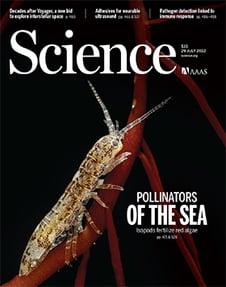
Figure: The cover of Science journal Volume 377 (6605). An isopod (Idotea balthica), a type of crustacean, covers itself with male gametes while feeding on the epiphytes of the red alga Gracilaria gracilis. Isopods facilitate algal fertilization by carrying spermatia on their bodies. Such animal-mediated fertilization is akin to pollination in flowering plants. Figure and legend reproduced under fair use.
[1]. Ollerton, J. and Ren, Z-X (2022) Did pollination exist before plants? Science. 377 (6605), p. 471-472. https://www.science.org/doi/10.1126/science.add3198
[2]. Lavaut E, Guillemin M-L, Colin S, Faure A, Coudret J, Destombe C, Valero . (2022) Pollinators of the sea: A discovery of animal-mediated fertilization in seaweed. Science. 377 (6605) p. 528-530. https://www.science.org/doi/10.1126/science.abo6661
[3]. Fuster F, Kaiser-Bunbury C, Olesen JM and Traveset A. (2019) Global patterns of the double mutualism phenomenon. Ecography. 42: 826–835. https://onlinelibrary.wiley.com/doi/epdf/10.1111/ecog.04008
