The last two articles I have written, on invertebrate and vertebrate mouths, were quite long. I suspect you are all exhausted from reading (if you even did!) those articles; for sure, I have worn my fingertips down to the nub. So I will keep this article short. It is based on an article on a gardening columnist in Alaska, someone (else?) with incredible stamina, and who ended up contributing hugely to science, albeit inadvertently.
Jeff Lowenfels lives in Anchorage, Alaska. He has been writing a weekly column on gardening since 1976. He was profiled in the New York Times [1] and I found the article fascinating. I know fellow columnists would agree that it’s hard to write a regular column: the ideas don’t come; the writing gets bogged down; the column is too short or too long; or – this is my problem – it is not interesting enough for the varied readership. Mr. Lowenfels got around problem #1 quite easily – he gave advice for what to do in the garden on a weekly basis for Anchorage readers. His readers would be advised, each week of each year, on the seeds suitable for planting, seedlings suitable for transplanting, harvest time, new cultivars suitable for the Alaskan climate, and a lot about tomatoes. Tomatoes are finicky. They need lots of sunshine and high temperatures to ripen. They are susceptible to all manner of diseases They were not even worth planting in Alaska due to too-low temperatures and not enough days of full sun when Lowenfels started his columns, so he dissuaded their plantings back in 1976. The other thing was lawns: Lowenfels had what I call “turf disease”: a yearning for lawns that were dandelion-free, perfectly green, perfectly groomed and, in my opinion, perfectly unsuitable for living things. Lowenfels advised using fertilizers on lawns, and 2,4-D on dandelions. He advised the plantings of what we now recognize as invasive non-native plants, and the eradication of those pesky bugs. It was how people gardened, nay lived, back then.
Then, something life-changing happened to Lowenfels. In 2002, a fellow gardener sent him an electron microscope micrograph of a fungal hypha strangling a nematode (see Figure 1). Lowenfels was shocked. He had never credited that the soil under his feet contained a whole ecosystem of life, and that the delicate balance of that life was being assailed by the chemicals he was advising his readers to use. He henceforth foreswore pesticides and herbicides. And he apologized to his readers.
In my eyes, that was a brave, worthy, and honorable thing to do.
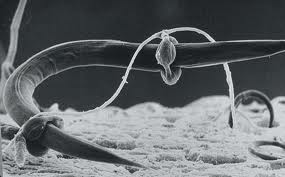
Figure 1: Nematode trapped by fungal hypha. Credit: https://microbewiki.kenyon.edu/index.php/File:Ring_trapping-2.jpg
Lowenfels went on writing his columns, scrutinizing the weather and advising gardeners. He noticed, as the years progressed, that those tomatoes that he had deemed unsuitable for Alaska were starting to first put out fruit, and then to ripen. Okra, a quintessential warm weather plant, started to grow. Invasive southern plants migrated into the area and took root. The daylilies he had brought with him from New York years ago, in memory of his father, put out their first flower. Drought-intolerant spruce trees died. It was getting warmer and drier in Southcentral Alaska, presaging a shift towards deciduous trees in the not-too-distant future.
Phenology is the study of the interactions of living organisms and climate. The periodicity of plants – germinating, greening, flowering, ripening; and those of animals – mating, hatching, migrating – all these are phenological milestones. Monitoring behavior and periodicity and linking it to the environmental conditions allows phenology researchers to track how climate affect life patterns. If the patterns change, and the climate is also changing, an association that is causal, rather than merely correlational, can be inferred.
In Lowenfels’ columns, these changes, documented weekly over 45 years of the most profound global warming period in the most profoundly affected region of the world, have been a boon for climate researchers. Data collected across the globe are testifying to real, concrete changes. How are temperatures measured? Well, first, your tax dollars are at work to measure a bunch of things through the National Oceanic and Atmospheric Administration (NOAA). There are buoys floating in the oceans around the world, put in place by the National Buoy Data Center (https://www.ndbc.noaa.gov/); geostationary satellites deployed around the globe measure radiation, cloud cover, temperatures, thicknesses of various atmospheric layers, layers of sea ice; measurements of wind, rainfall, temperatures, particulate matter and other data are obtained around the globe; and real people trek up mountains to measure snow cover and to Antarctica to measure glacier movement. Real time data and historical recordings, and forensic recordings taken from tree growth rings, soil and rock inclusions, ice core samples, and so on allow reconstruction and the development of models. Scientists have modeled shifts in climate, weather and sea current shifts, magnetic pole drifts, and temperature and rainfall. Models based on data are then used to extrapolate the findings to greater increases in temperature and to see how that would shift the climate. These models are used to explain the loss of polar ice, the earlier and fiercer wildfires, hurricanes, rainfall and floods, droughts, polar vortexes and shifts in the jet stream and the Gulf stream, the relentless northwards movement of invasive species, and the ability to grow daylilies, tomatoes, and okra in Alaska.
Beekeepers are doing a service to science too, without our even knowing it. Our records are our contribution. Our monthly newsletters in years to come will be primary source documents – timelines for the ordering of nucs, the emergence of bees from the winter huddle, the questions about queen raising, nectar flows, the first swarms, harvesting; the types and timings of plants in bloom (Horticulture and Citizen Science Committees, I’m looking at you!) These are periodic events that are clearly related to climate. (Here, I want to give a shout out to Tim Sterrett, columnist extraordinaire and phenologist who documented the seasonal plants, animals, and celestial events over ten years for us at the PSBA and CCBA. Thank you, Tim. Your columns were edifying and enjoyable!)
Here’s a suggestion: Along with recording the ups and downs of the hive, wouldn’t it be helpful if we could keep track of the plants that are thriving, suffering, blooming; the other insects around; the birds hatching, fledging, migrating. Each of us can provide data from our various locations for future researchers. One day, a column in the New York Times may feature us, the inadvertent phenologists.
References:
1. St.George, Z., He Wrote a Gardening Column. He Ended Up Documenting Climate Change. @nytimes. 2021
URL: https://www.nytimes.com/2021/07/28/magazine/gardening-column-climate-change.html

