This month, I want to share some thoughts about Recently, I visited some dissimilar but iconic museums: Yale University’s newly refurbished Peabody Museum in New Haven CT, the Brandywine Museum of Art in Chadds Ford PA, the Children’s Museum of Delaware in Newark DE and the Library of Congress and the Botanical Gardens in Washington DC. The last two do not have “museum” in their name, but their mission is to advance public understanding in one or multiple fields. They often tie disparate fields together in authentic ways, such as the acronym STREAM (science, technology, reading, engineering, art, music), or natural history (biology and geology) or anthropology (STREAM + history). What impressed me most was that the most hallowed museums in this list – Library of Congress, the Botanical Gardens and the Peabody are free, although reservations are required. These places were naturally teeming, with students, young parents with excitable toddlers, tourists and information junkies like me who had come there for food for thought at no charge.
The Peabody Museum has a natural history and anthropological tilt, and it is awesome for its groundbreaking fossils and artifacts which have scientific and cultural oomph (https://youtu.be/nSwJs53QYrw). The exhibits are outstanding, breathtaking, even. They are displayed with technical accuracy and the captions are in simple and accessible language: I heard adults reading out highlights to their preschool children. Although the most scientifically precious exhibits were displayed behind protective glass, there were plenty of interactive exhibits to keep everyone engaged. Student docents manned “touch me” tray containing a cast of an 8-inch-long Tyrannosaurus rex tooth and real fossils of trilobites and spoke with knowledge and enthusiasm. The Library of Congress, which I am ashamed to confess I had not been to before despite many visits to Washington DC, was dazzling. Touchstones of history included a copy of the Golden Record that was sent on the Voyager missions, and it is possible to listen to the messages including greetings spoken in 55 languages! In its own hallowed room is Thomas Jefferson’s library purchased by Congress as the nucleus to rebuild the library after the British sacked and burned Washington DC in 1814 (part of the War of 1812). A Gutenberg Bible displayed in the entrance lobby is printed entirely on vellum and one of only three copies of its kind in the world; it probably dates back to the 1450s – almost 600 years ago! Then there the only surviving 1507 “Waldseemüller’s map” dedicated to the Italian explorer and cartographer, Amerigo Vespucci, after whom Waldseemüller named the freestanding continents new to Europeans. Despite its pivotal importance as “America’s birth certificate”, this map was only acquired in 2003. All this is found in a sumptuously decorated building with murals, allegorical paintings everywhere and it felt like my head was on a swivel and my eyes on stalks. The United States Botanical Gardens (aka Bartholdi Fountains and Gardens) are near the Congress Building and provided refuge and respite from the sun on a hot summer’s day. The plant variety (from all over the world) is amazing. It is also the oldest continuously operating Botanical Gardens in the United States. The Brandywine Art Museum contains paintings and sculptures which invite interest in the local community and nature and relationships. It is a welcoming and mellow place, with sitting areas with views over the Brandywine River and a nice café, also with views. What is not to like? And finally, I went with two buzzing children of a friend to the Delaware Children’s Museum where they and I played with gusto with water features to fingerpainting to bumper cars, laughing all the way. Fossils, paintings, and interactive fun. So, what is it that makes such disparate places museums?
According to Mirriam-Webster, a museum is “an institution devoted to the procurement, care, study, and display of objects of lasting interest or value; also : a place where objects are exhibited.”[1] The word “museum” comes from the Ancient Greek word “mouseion” which refers to a temple to the muses, the divine patrons of the arts. A museum invites contemplation and reflection, and to understand context and composition. The nine named Greek muses are associated as follows, and the following is summarized from [2]
1. Calliope: Muse Calliope was the superior Muse. She accompanied kings and princes to impose justice and serenity.
2. Clio: The Muse Clio discovered history and guitar. History was named Clio in the ancient years, because it refers to “kleos” the Greek word for the heroic acts.
3. Erato: Muse Erato was the protector of Love and Love Poetry – as well as wedding. Her name comes from the Greek word “Eros” that refers to the feeling of falling in love.
4. Euterpe: Muse Euterpe discovered several musical instruments, courses and dialectic (discussions).
5. Melpomene: Opposite from Thalia, Muse Melpomene was the protector of Tragedy; she invented tragedy, rhetoric speech and melos (tunes).
6. Polyhymnia/Polymnia: Muse Polymnia was the protector of hymns and mimic art; she invented geometry and grammar.
7. Terpsichore: Terpsichore was the protector of dance; she invented dances, the harp and education.
8. Thalia: Muse Thalia was the protector of comedy; she discovered comedy, geometry, architectural science and agriculture.
9. Urania/Ourania: Muse Ourania was the protector of celestial objects and stars; she invented astronomy.
She was the protector of heroic poems and rhetoric. According to the myth, Homer asks Calliope to inspire him while writing Iliad and Odyssey, and, thus, Calliope is depicted holding laurels in one hand and the two Homeric poems in the other hand.
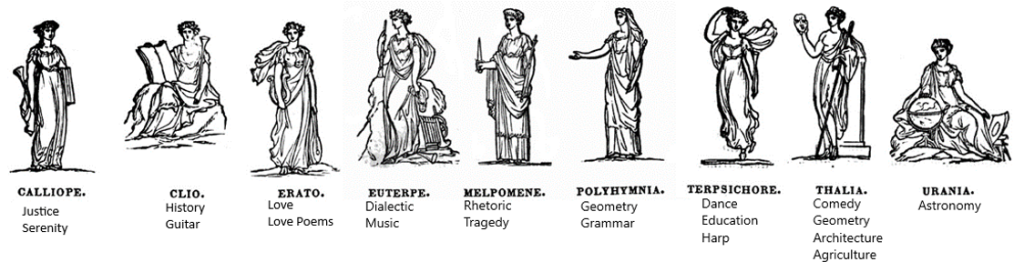
Figure adapted from https://ar.inspiredpencil.com/pictures-2023/greek-writing-muse. Reproduced under Fair Use copyright.
From this wide swath of patronage, it is clear the term “museum” can cover all manner of arts, sciences, theater, observatories and emotions. Yet, the question remains: Are museums homages to the past or staircases to the future? After all, many museums are arranged chronologically/geographically as repositories to objects signifying cultures or movements from the past, with the pejorative term “dusty” often applied. But the museum’s mission can make them staircases. In my view, the ethos in museums is changing to encourage engagement, and from the shrieks of happy kids at the Delaware Children’s Museum to the awed murmurings at the Peabody, it is working.
Bibliography
[1]. Merriam-webster.com. (2019). Definition of MUSEUM. [online] Available at: https://www.merriam-webster.com/dictionary/museum.
[2]. Greek Myths & Greek Mythology. (2010). The Nine Muses of the Greek Mythology. [online] Available at: https://www.greekmyths-greekmythology.com/nine-muses-in-greek-mythology/.
