This is the second in a series of articles that examine the senses that living organisms use to understand their environment and respond accordingly. Chemosensation is the ability to detect chemicals in the environment and was the earliest sense to evolve. Matter is made of chemicals: molecules which compose, exude from, and are ingested by, every single living organism. Over evolutionary time, the chemosensory system was honed to detect more and more chemicals and to classify them as desirable, benign or dangerous. This article will explore the mechanisms by which this system originated and evolved. The video below breaks down how chemosensation occurs (Figure 1). As we think of it today, chemosensation is divided into olfaction (smell) and gustation (taste) in most vertebrates by separating smell (nose) from taste (mouth) but, earlier in evolutionary time, it was combined into one sense.
Figure 1: Video of Ancestral and Weird Senses, Crash Course in Zoology #8, is from PBS.org (https://www.pbs.org/wnet/nature/crash-course-zoology-episode-8-ancestral-weird-senses/32263/) and reproduced under fair use for educational purposes.
First, to answer the question: how did chemosensation originate? Before single cells diverged into the two first great domains, Archaebacteria and Bacteria, they would have had a membrane studded with all kinds of receptor (receiving) molecules. Molecules get recognized through a coupling reaction – a molecule (ligand) that fits into another molecule (receptor) – is how it all began. The environment in which the earliest cells evolved was probably aqueous. Dissolved molecules which could serve as food before the evolution of photosynthesis had to be snared from the environment. To do this, random evolution would have occasionally thrown up membrane-bound proteins that would bind to a food molecule, analogous to how a pebble sometimes lodges in a shoe or car tread. Once seized, this molecule provided energy as it was broken down in the cell by enzymes, providing energy for the cell to divide. The offspring inherited the receptor genes from the parent, and mutations leading to a slightly better fit of the cavity in the tread would have made it more efficient at gathering energy-supplying molecular pebbles. Neuroscientist Niko Kukushkin explains that an organism is defined by any part, structure or gene that has thrown its lot in with others such that “they”, the group, live or die together. If any part can spin off and survive, it is not part of an “organism”. [1] Once committed to a consortium, however, the whole structure stands or falls by the success or failure of each part of the system. This is a machine that succeeds or fails based on cooperation. This “together we succeed or fail” mechanism allowed behaviors as vastly different as identifying food and partners, avoiding predators and poisons, and marking territory. Yohe and Brand (2018) explain the proliferation of senses through a “divergent selection for efficient signal transmission among heterogeneous environments” to allow rapid adaptation. [2]
In this scenario, being able to filter noise out of an environment cluttered with all sorts of cues is critical for survival. This is done by honing the pathway which links the perception of a specific cue to a behavior that is adaptive. For example, the Iberian wall lizard, Podarcis hispanicus, lives in two different environments: one cold and humid in northwestern Iberia [3], and the other in south central Iberia, which is warm and dry. The two sets of lizards produce, and respond to, chemicals with different compositions, size, and volatility. Why did the receptors and ligands diverge so much between these otherwise closely related lizards? This must be environment-related, and speaks to the nimbleness of chemosensory adaptations (Figure 2). (If the behavior is not adaptive, the organism dies and the genes for the detrimental behavior are lost together with all the others that were in the consortium.) As time went on, as life-forms proliferated, and as ligands and their receptors diverged more and more, animals evolved anatomical structures and a brain, and the sense of smell got separated from the sense of taste. The key differences between the two are that, in taste, the receptors are in the mouth, require direct contact with the material, and require the ligands to be dissolved in an aqueous medium such as water or saliva before perception (restricting taste to water-soluble molecules). Smells, on the other hand, are not restricted to water-soluble molecules, but waft through any medium, water or air, can be perceived at a distance, and the receptors are located in the nose. Smell allows odoriferous molecules which are often water-insoluble, such as terpenoids (vanillin, menthol and limonene) and lipids such as rancid butter (butyric acid), to be perceived. Animals which live predominantly in water, like fish, do not clearly distinguish the two, so sharks “smell” using receptors located in their nasal cavities and catfish “taste” using receptors located all over their body other than their nasal cavities.
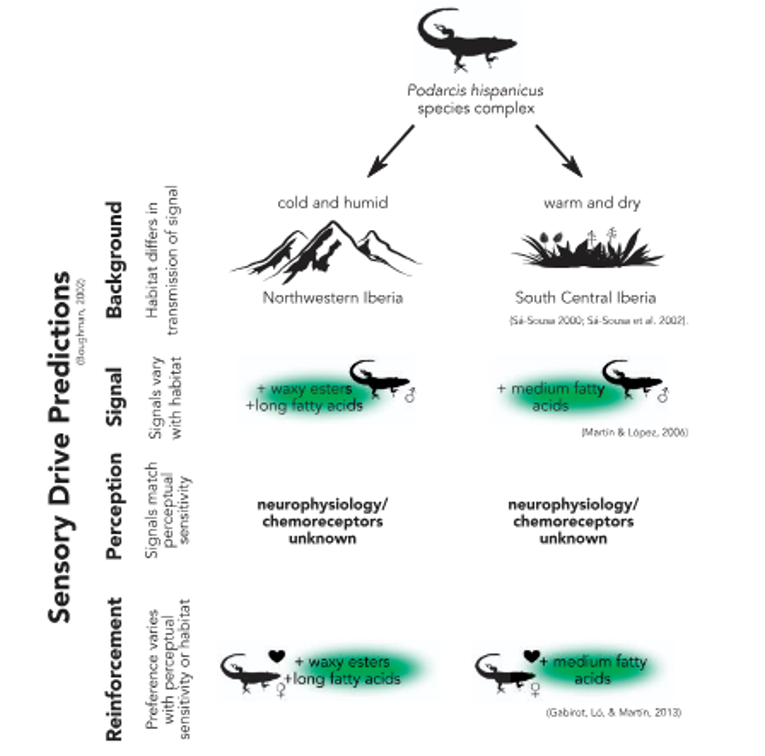
Figure 2: The Iberian wall lizard Podarcis hispanicus illustrates a strong candidate for sensory drive promoting chemosensory divergence and local adaptation. Compounds of the male femoral gland excretions differ based on the environment, in which northern populations have waxier and bulkier compounds that are less volatile and enable more viable signals in the given habitat. Receptors of the perceivers are unknown, but behavioral evidence has demonstrated female preference and male–male recognition of signals based on their own environments. Silhouettes are from vecteezy and all-free-download.com. Figure and legend reproduced from Yohe and Brand [2] under fair use.
The earliest animals which made a distinction between taste and smell were probably land animals, because they distinguish direct food contact from air carrying odor molecules. Pesky invertebrates like fruit flies and mosquitoes, which can sniff out a rotten banana or a yummy human, have a pretty small complement of about 62 odorant and 68 gustatory receptors (fruit fly) and 85 odorant and 76 gustatory receptors (mosquitoes). [4] But these are a tiny blip on the number and variety of vertebrate receptors, because vertebrates developed a tongue for manipulating food in the mouth to be crushed by teeth, and noses with which to parse the information wafted at them. Teeth are bony outcrops of internal skeletons, and these are restricted to starfish [5] and the familiar vertebrates, such as fish, amphibians, reptiles, birds and mammals. As noted above, fish probably use their tongues (where they exist) largely as tools for manipulation. In fact, the tongue louse, Cymothoa exigua, bites down on the blood supply to the tongues of fishes until they fall off from exsanguination; then it attaches itself to the stubby root, becoming a tongue replacement. The fish does not seem to notice or mind, and the louse gets a share of all the food the fish consumes.

Figure 3: Cymothoa exigua, or the tongue-eating louse, is a parasitic crustacean of the family Cymothoidae. The parasite enters fish (here a Sand steenbras, Lithognathus mormyrus) through the gills and then attaches itself to the fish’s tongue. Photo by Marco Vinci. Reproduced from https://en.wikipedia.org/wiki/Cymothoa_exigua under CC BY-SA 3.0 copyright license.
From the molecular receptor perspective, the human tongue has about 5,000 “taste buds” which contain G-protein coupled receptors. [6] Taste buds contain three types of receptors which respond to different stimuli, and are distributed around the tongue. [7] Smell receptors are also G-protein coupled (not surprising, since they share origins), but their genes are located in a section of the chromosome that is particularly vulnerable to copying errors, and thus mutations occur at a high rate, increasing the diversity of receptors to bind odors not yet encountered. In fact, this is one of the great strengths of the odorant receptors (so far ~400 different genes have been identified in humans, ~1,100 in the mouse, and ~2,000 in elephants; Figure 4), [8] but it also appears that other families of chemosensory receptors (called “atypical receptors”) contribute to smell. Regarding the odor response, the olfactory epithelium of the average human nose contains 50 million receptors organized into 9–12 zones. Despite this, humans have a blunted sense of smell. Reptiles, amphibians and some mammals have a Jacobson’s organ (also called a vomeronasal organ), which is an auxiliary smell organ located in the oral cavity. When snakes flick their tongue or a horse curls back its lip (called a Flehmen’s response), it is funneling air carrying odor molecules across this organ, which contains receptors that can finesse the perception. Still, smell and taste senses work together in many animals, allowing an extremely sensitive response to environmental cues and a way for oenophiles to feel superior.

Figure 4: An infographic detailing the olfactory abilities of elephants and other placental mammals. (Image credit: Karl Tate, Infographics Artist.) Reproduced from https://www.livescience.com/animals/which-animal-has-the-best-sense-of-smell under fair use copyright license for educational purposes.
Where do bees fall in the chemosensory ability list? Bees use taste for food, water, and nestmate recognition. They also communicate with pheromones, as anyone knows who has ever been on the pointy end of bees taking umbrage, which leaves a faint banana smell in the air due to the presence of isoamyl acetate. The taste sensory structures are located on the antennae, mouthparts, and forelegs (thus bee-fficiently picking up chemicals in the air, by tasting with the mouth, and by standing on them). Thus olfaction and gustation are the same in bees. Incidentally, bees reject bitter and salty solutions, so they must taste them; but if forced to consume them under laboratory conditions they can become morbid or die. [9]
To cap, a few facts:
Best and worst sense of taste: The catfish has the most exquisite sense of taste, because it has taste buds – approximately 150,000 of them – all over its skin (other than the nostrils). Birds have a poor sense of taste, because they have few taste buds. [10] You may have noticed they cannot taste hot peppers; a trick to keep squirrels (which can) away is to liberally sprinkle red pepper flakes all over birdseed.
Best and worst sense of smell: The African giant pouched rat has a phenomenal sense of smell and is used to sniff out both landmines and tuberculosis. [11] In the bird family, vultures smell well and songbirds smell poorly, since they lack any olfactory system at all. [12]
The big question: Elephants have more smell-related genes than any other land vertebrate so far examined (plus an elephant never forgets!), and sharks supposedly can smell a drop of blood from a quarter of a mile away. Which one would win the smell test?
References
[1] Skeptic (2026). What Makes You ‘You’ When Everything Is Just Atoms? Available at: https://www.skeptic.com/michael-shermer-show/what-makes-you-you-when-everything-is-just-atoms/ [Accessed 21 Jan. 2026].
[2] Yohe, L.R. and Brand, P. (2018). Evolutionary ecology of chemosensation and its role in sensory drive. Current Zoology, 64(4), pp.525–533.
[3] Iberia refers to the peninsula of Spain and Portugal.
[4] Bargmann, C.I. (2006). Comparative chemosensation from receptors to ecology. Nature, 444(7117), pp.295–301. doi:10.1038/nature05402.
[5] Yes, indeed. Although not of the same composition as our bones, the spiny outer covering of starfish and their ilk is an endoskeleton made of calcium carbonate.
[6] G proteins act like molecular switches upon the binding of the cognate ligand and a molecule of GTP (guanosine triphosphate), which provides energy. When both are bound, the G-protein triggers a signal to pass between the taste bud and the brain.
[7] Roper, Stephen D., and Nirupa Chaudhari. “Taste Buds: Cells, Signals and Synapses.” Nature Reviews Neuroscience, vol. 18, no. 8, 2017, pp. 485–497. doi:10.1038/nrn.2017.68.
[8] This spectacular diversity mimics the diversity of antibody-producing genes in our body – our immune system can generate about one quintillion (1,000,000,000,000,000,000) different antibodies from a cluster of 30,000 genes.
[9] de Brito Sanchez, M.G. (2011). Taste Perception in Honey Bees. Chemical Senses, 36(8), 675–692. doi:10.1093/chemse/bjr040.
[10] Futterman, Allison. “These Animals Have the Best and Worst Sense of Taste.” Discover Magazine, Oct. 2024.
[11] Gale, Jen. “What Animals Have the Strongest Sense of Smell?” Institute for Environmental Research and Education, 19 Oct. 2025.
[12] Young, Laura. “What Animals Can’t Smell?” Institute for Environmental Research and Education, 21 Sept. 2025.
